
The race to build the next generation of low-power, high-efficiency Edge-AI chips is heating up fast. Today, we can see tech giants like Google, Meta, and Tesla investing billions of dollars into custom silicon. However, the next generation of AI won’t rely solely on massive cloud servers. It will run directly on the devices we use every day; our phones, industrial machines, cameras etc.
However, behind this rising competition, ChipForge by TATSU, the world’s first decentralized chip-design project, is quietly building a radically different path forward. The project opens the door for global talent, reduces traditional research and development (R&D) costs, and speeds up innovation through real, decentralized competition.
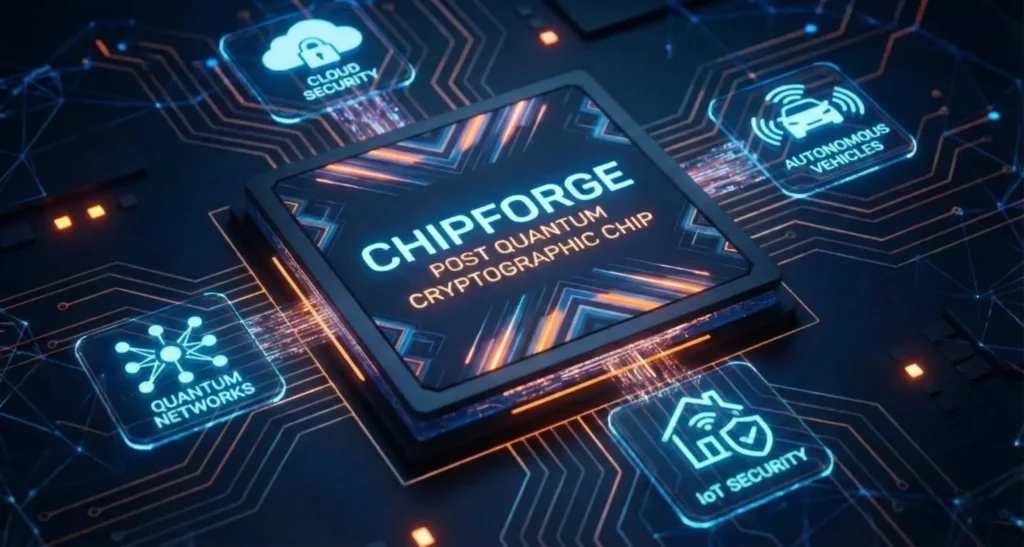
ChipForge’s Operating Model for Chip Development
Most chip projects move slowly because they follow hierarchical processes and fixed design cycles. ChipForge operates like a global hackathon that never ends. Engineers compete head-to-head for rewards, creating a culture of rapid innovation where only the best-optimized submissions earn alpha token rewards.
This competitive model produces rapid iteration and measurable breakthroughs in far shorter timeframes than conventional chip development. It also removes geographic, academic, and corporate barriers. Provided you have the technical knowledge, you can contribute, learn, and get paid.
ChipForge has already achieved what many thought impossible in the chip industry. Through open, blockchain-driven engineering competitions, the project has produced a complete industrial-grade RISC-V processor with built-in cryptographic capabilities. Every part of this processor was designed by miners who competed in decentralized challenges, rather than by engineers at a traditional semiconductor company, like the ones we’re used to. Submitted designs are evaluated on critical optimization metrics that include:
- Power consumption: Essential for battery-powered Edge-AI devices
- Area efficiency: Reducing chip size lowers manufacturing cost
- Performance: Ensuring competitive processing capability
- Synthesizable RTL output: Designs that can be deployed on FPGA hardware today
This combination of professional tooling, open participation, and competitive incentives creates a design pipeline that is unusually fast, cost-effective, and globally accessible.
What This Means for Edge-AI
Edge computing is on the rise. Today, we can use smart cameras, autonomous drones, medical wearables, robotics, and home devices that all require chips designed for low-power, low-latency AI inference. But designing such chips is very expensive. Industry research gives us a clear picture:
- A sophisticated AI SoC can cost $80 million to $200 million to design.
- A 5nm chipset can exceed $540 million in development cost.
- Even older 40nm designs cost at least $2 million.
- Cutting-edge 2nm chips now require over $725 million.
This cost barrier is why only a handful of corporations control the global semiconductor industry. ChipForge completely changes this narrative. Instead of building a massive engineering team, it pays only for top-performing designs, massively reducing R&D spend. This makes innovation faster and far more affordable, and it opens chip engineering to talent outside traditional institutions.
Why RISC-V Makes ChipForge Even More Impactful
RISC-V, the open-source instruction set architecture used by ChipForge, is already reshaping the semiconductor landscape. Major companies and corporations are already moving fast with such deployment. These companies include:
- NVIDIA has quietly used RISC-V microcontrollers for years and recently made CUDA compatible with RISC-V.
- Google, Intel, Qualcomm, Red Hat, and Samsung have backed the RISE project to accelerate RISC-V development.
- Google now treats RISC-V as a first-class architecture for Android.
- Intel has also launched a $1 billion fund to support RISC-V ecosystems.
With the world’s largest technology firms embracing RISC-V, ChipForge’s open, competitive approach aligns perfectly with industry trends and momentum.
The Roadmap: Toward Real Edge-AI Silicon
ChipForge’s next phase positions the project as a launchpad for the most energy-efficient AI chips of the coming decade.
Upcoming milestones include:
- Hardware-Software Co-Design: In addition to designing chips, miners will also design compilers, runtimes, and AI kernels that run on those chips. This optimizes compilers, runtimes, and AI kernels alongside the hardware to deliver the best end-to-end edge-AI performance.
- Specialized Edge-AI NPUs: It will create neural processors tailored for low-power, on-device AI
- From FPGA to Real Silicon: The project will participate in fabrication programs like Google’s OpenMPW shuttle.
- Quantum-Safe Cryptography: This will help future-proof designs against emerging threats.adding protection against future quantum threats
Each step pushes ChipForge closer to delivering real, market-fit Edge-AI chips designed by a global, decentralized community.
Conclusion: Why ChipForge Could Quietly Define the Future
ChipForge blends open-source hardware, blockchain incentives, and competitive engineering into a model that scales innovation faster and cheaper than traditional semiconductor firms can manage. By decentralizing chip design and pushing aggressively toward Edge-AI specialization, ChipForge is on course to become the launchpad for the next wave of low-power AI silicon.
This is not just another blockchain project. It’s a new blueprint for how chips can, and will likely be built, in the AI era.
Previous Articles:
- State Street, Galaxy, Ondo Launch Tokenized Liquidity Fund on Solana
- Gladinet Flaw: Hard-Coded Keys Enable Remote Code Execution Exploit
- Tom Lee Says Crypto Still in 1996 Era, Big Price Surge Ahead
- Crypto Liquidations Surge Over $514M in Major Market Reset
- Asian Bishops Draft AI Ethics Guidelines for Church Use

