
- The Regulatory Landscape and Why New York Stands Apart
- Legal Exchanges for New York Residents
- Restricted Platforms and Common Pitfalls
- Available in NY
- NOT Available in NY
- The Mining Moratorium and Environmental Policy
- Tax Implications for NY Crypto Investors
- Institutional Crypto and Innovation in NYC
- Future Outlook and Legislative Changes to Watch
- How to Stay Compliant
- SOURCES
TL;DR: Trading crypto in New York is legal but heavily regulated by the New York Department of Financial Services (NYDFS). Platforms must hold a BitLicense or a Limited Purpose Trust Charter to serve NY residents. As of the latest NYDFS registry, roughly 35 entities hold some form of virtual currency authorization [1]. The Greenlist, which dictates which coins licensed firms can offer without prior approval, contains only 8 assets. A two-year proof-of-work mining moratorium expired in November 2024, and new environmental legislation is under consideration. This guide covers which platforms are legal, how taxes work, and what New York crypto residents need to know to stay compliant.
The Regulatory Landscape and Why New York Stands Apart
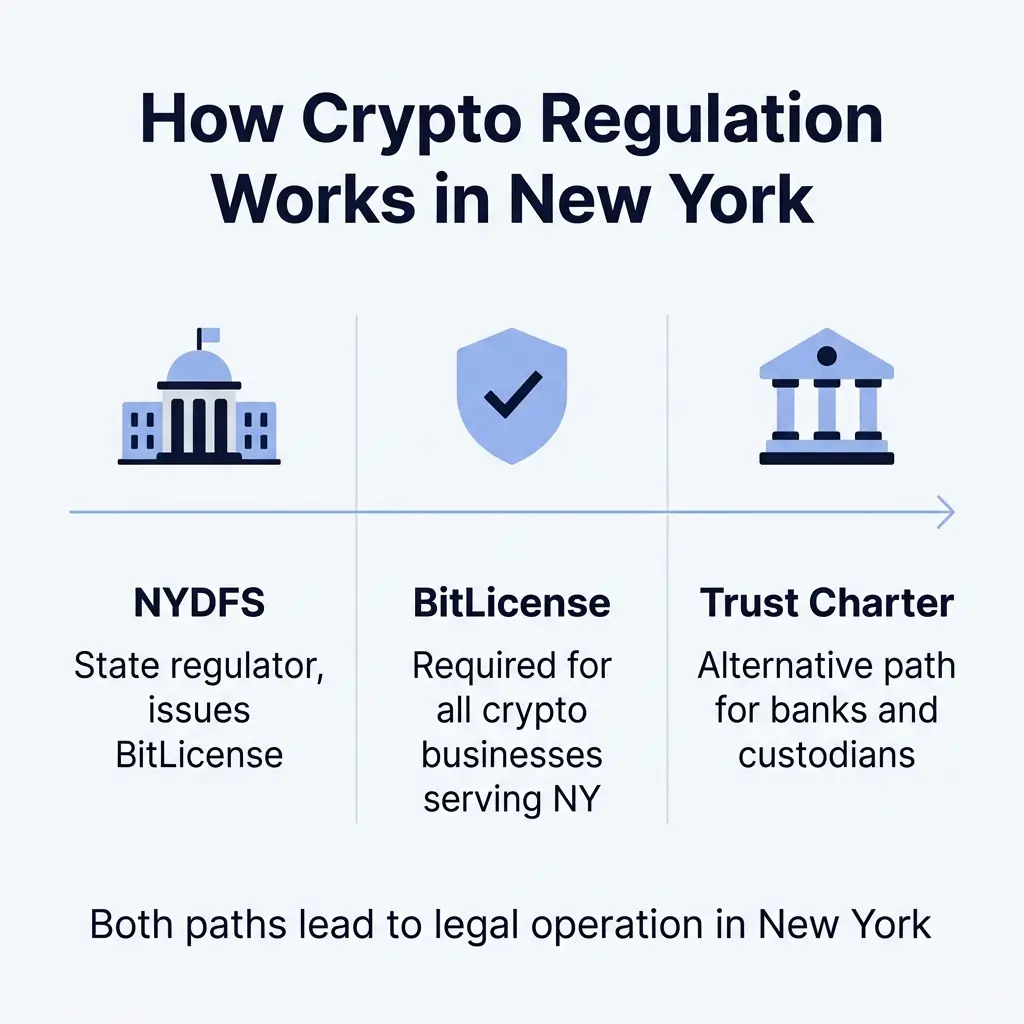
New York treats crypto exchanges as financial service providers. Most other states treat them as technology platforms [2]. That distinction drives everything about how crypto in New York operates.
The NYDFS holds primary authority over virtual currency businesses in the state. Governor Andrew Cuomo’s administration authorized the agency to draft rules in 2013, and in June 2015, regulation 23 NYCRR Part 200 took effect [1].
This regulation created the BitLicense = a mandatory business license for any entity conducting virtual currency activity involving New York or a New York resident.
The BitLicense applies to five categories of activity, including:
- receiving or transmitting virtual currency,
- providing custodial services (holding crypto assets on behalf of customers),
- buying and selling crypto as a customer-facing business,
- performing exchange services, and
- controlling or issuing a virtual currency [1].
Individual investors do NOT need a BitLicense. You only need one if you run a business serving others.
“What about banks?”
Some financial institutions bypass the BitLicense entirely by obtaining a Limited Purpose Trust Charter under New York Banking Law.
This charter allows companies to exercise fiduciary powers (the legal authority to manage assets on behalf of clients), something a standard BitLicensee cannot do. It also permits money transmission in New York without a separate transmitter license [1].
Gemini Trust Company, LLC, for example, received its charter in October 2015 and operates under this model [1].
How does this differ from federal oversight?
The SEC and CFTC regulate crypto at the federal level, primarily around securities classification and derivatives.
New York adds a STATE layer on top of that federal framework. A company can be fully registered with FinCEN and still need a BitLicense to operate in NY [1].
This double layer of regulation makes New York the most expensive and demanding crypto market in the United States for service providers.
Legal Exchanges for New York Residents
Why are so many exchanges unavailable to NY residents?
The application process for a BitLicense requires extensive background checks, cybersecurity audits, anti-money-laundering (AML) programs, capital reserve requirements, and a minimum $500,000 surety bond (a financial guarantee protecting customers) [1].
The cost and timeline deter most companies from applying.
As of the most recent NYDFS registry, here are the major platforms licensed to serve NY residents [1].
| Platform | License Type | Year Granted | Key Feature for NY Residents |
|---|---|---|---|
| Coinbase | Virtual Currency + Money Transmitter + Trust Charter | 2017 / 2018 | Broadest coin selection, staking, fiat on-ramp |
| Gemini | Limited Purpose Trust Charter | 2015 | NY-native, issues GUSD stablecoin |
| Robinhood Crypto | Virtual Currency + Money Transmitter | 2019 | Commission-free trading, limited wallet features |
| PayPal / Venmo | Trust Charter + Virtual Currency + Money Transmitter | 2022 / 2024 | Buy and hold within app, limited transfers |
| Block (Cash App) | Virtual Currency + Money Transmitter | 2018 | Bitcoin-only, simple interface |
| Fidelity Digital Assets | NY State Trust Company License | 2019 | Institutional-grade custody, BTC and ETH |
| eToro | Virtual Currency + Money Transmitter | 2023 | Social trading features |
- Coinbase received both its Virtual Currency License and Money Transmitter License in January 2017. Coinbase also operates Coinbase Custody Trust Company under a Limited Purpose Trust Charter granted in October 2018. NY residents can trade, stake, and store a range of tokens through Coinbase, making it one of the broadest fiat on-ramp options (a service that lets you convert U.S. dollars into crypto) in the state.
- Gemini, founded by Cameron and Tyler Winklevoss, is the NY-native exchange. It received its Limited Purpose Trust Charter in October 2015, making it one of the first two entities licensed under NYDFS virtual currency rules [1].
Gemini also issues the Gemini Dollar (GUSD), an NYDFS-approved stablecoin on the Greenlist.
- Robinhood Crypto holds a Virtual Currency License and Money Transmitter License, granted in January 2019 [1].
NY residents can buy and sell crypto through the Robinhood app, though wallet functionality and transfer features are more limited compared to Coinbase or Gemini.
- PayPal and Venmo operate through PayPal Digital, Inc., which received a Limited Purpose Trust Charter in May 2024, and PayPal, Inc., which holds both virtual currency and money transmitter licenses [1].
The catch is that PayPal and Venmo function as “walled gardens.” You can buy and hold crypto, but transferring assets off-platform has historically been restricted.
- Block, Inc. (formerly Square) holds its license since June 2018 [1].
Through Cash App, NY residents can buy and sell Bitcoin.
- Fidelity Digital Assets secured a New York State trust company license in 2019, allowing it to provide institutional-grade custodial services and crypto trading to qualified clients [3].
Fidelity Crypto serves retail investors through the Fidelity brokerage platform, offering Bitcoin and Ethereum.
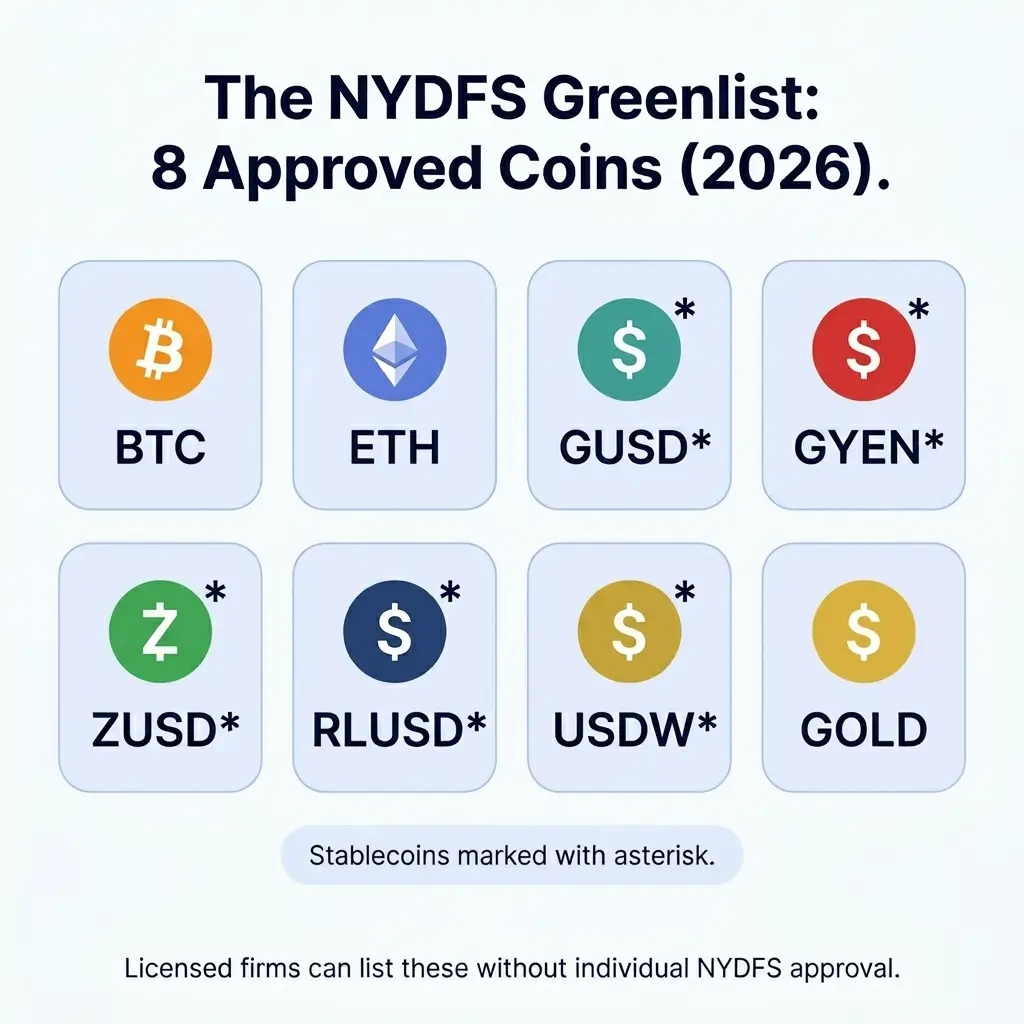
- The Greenlist dictates which coins licensed firms can list without individual NYDFS approval. After a major revision in September 2023, the NYDFS removed over two dozen tokens, including Dogecoin, Litecoin, and XRP, from the Greenlist [4].
The current Greenlist contains 8 coins:
- Bitcoin (BTC),
- Ethereum (ETH),
- Gemini Dollar (GUSD),
- GMO JPY (GYEN),
- GMO USD (ZUSD),
- Ripple USD (RLUSD),
- WisdomTree Dollar (USDW), and
- WisdomTree Gold (GOLD) [1].
Licensed firms can still list additional coins through a DFS-approved self-certification policy (a company’s internal process for vetting and approving new coins) or by filing a material change-of-business application, but both routes require significant compliance work.
Restricted Platforms and Common Pitfalls
- Binance does not hold a BitLicense. Neither Binance.com nor Binance.US serves New York residents [5]. Anyone with a New York ID or NY address cannot legally create or use a Binance account.
- Kraken withdrew from New York in 2015, calling the BitLicense requirements “abominable” at the time [6]. The exchange still does not serve NY residents for crypto trading or cash transfers as of 2026 [6].
Can You Use It in New York? Exchange Availability at a Glance
Available in NY
- Coinbase
- Gemini
- Robinhood Crypto
- PayPal / Venmo
- Cash App (Block)
- Fidelity Digital Assets
- eToro
- Bitstamp
NOT Available in NY
- Binance / Binance.US
- Kraken
- KuCoin
- Bybit
- OKX
- Crypto.com limited
- Gate.io
Based on NYDFS licensing records and exchange support pages. Verified March 2026.
“Can I use a VPN to access restricted exchanges?”
This is one of the highest-risk moves a NY resident can make. Licensed exchanges run KYC/AML checks that cross-reference your identity documents against your IP address and stated residency.
If an exchange detects a mismatch, it can freeze your account and all assets in it. You may lose access to your funds entirely.
There is no legal recourse to recover assets frozen because you violated the platform’s terms of service and state law.
Offshore “no-KYC” platforms carry even steeper risks.
Without KYC verification (the identity checks exchanges perform to confirm who you are), you have no consumer protection, no FDIC-equivalent coverage, and no regulatory body to file a complaint with.
The NYDFS has been clear that operating without a license in New York constitutes a violation of Financial Services Law, and the proposed CRYPTO Act (introduced January 2026) would make unlicensed virtual currency business activity a criminal offense [7].
The Mining Moratorium and Environmental Policy
Governor Kathy Hochul signed a two-year moratorium into law on November 22, 2022 [8].
The law banned the issuance of new permits for proof-of-work (PoW) cryptocurrency mining operations powered by fossil fuels.
It targeted operations like the Greenidge Generation facility on Seneca Lake, which converted a former coal plant to natural gas for Bitcoin mining.
That moratorium expired on November 22, 2024 [8].
New York Crypto Mining Moratorium: Key Dates
- Nov 2022 Kathy Hochul signs 2-year PoW mining moratorium into law
- Nov 2023 DEC misses deadline for environmental impact study
- Nov 2024 Moratorium expires; no new legislation in place
- May 2025 DEC publishes draft Generic Environmental Impact Statement
- Oct 2025 Senators Krueger and Kelles introduce new mining regulation bills
The law also required the New York Department of Environmental Conservation (DEC) to produce a Generic Environmental Impact Statement (GEIS) on crypto mining by November 2023.
The DEC missed that deadline, citing a lack of technical expertise [9].
A draft GEIS was finally published in May 2025 [10].
Is New York still a mining hub? The situation remains uncertain.
In October 2025, State Senators Liz Krueger and Anna Kelles introduced new legislation to establish a permanent regulatory framework for PoW mining, including a tax on mining operations and restrictions on companies operating under expired air permits [11].
Mining operations powered by renewable energy have continued to operate during and after the moratorium. The political direction in Albany leans toward further restrictions rather than expansion.
(Ed. note: If you plan to mine in NY, monitor the state legislature closely. New rules could materialize within months.)
Tax Implications for NY Crypto Investors
New York State treats cryptocurrency as property, consistent with IRS classification. Every sale, trade, or use of crypto to buy goods or services is a taxable event.
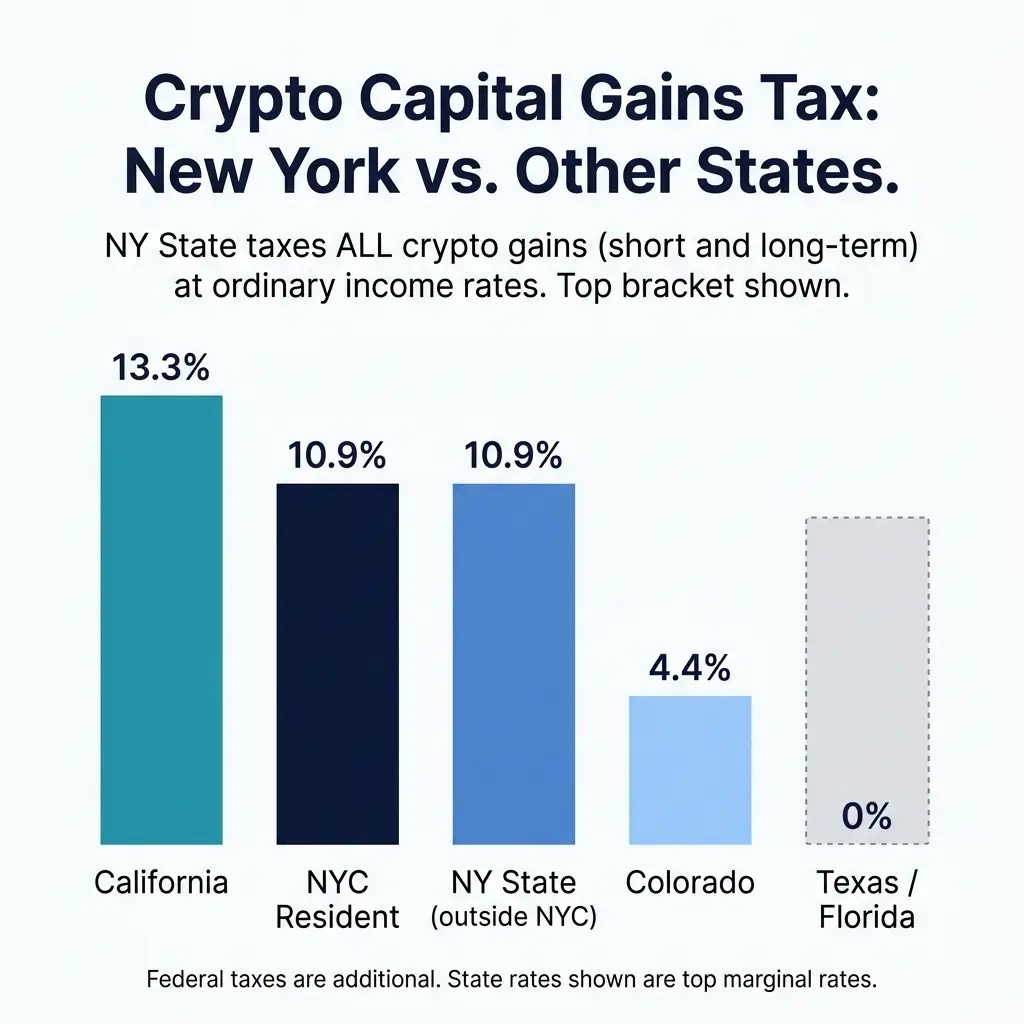
The tax burden on NY crypto investors is among the heaviest in the country. New York State does NOT offer a preferential rate for long-term capital gains [12].
Unlike the federal system, which taxes long-term gains at 0%, 15%, or 20%, New York taxes ALL capital gains, whether short-term or long-term, at your ordinary state income tax rate. That rate ranges from 4% to 10.9%, depending on your income bracket [12].
If you live in New York City, you pay an additional city income tax of 3.078% to 3.876% [12].
A NY resident earning $200,000 in combined income with $50,000 in long-term crypto gains could face a combined federal-state-city tax rate exceeding 30% on those gains. Compare that with a resident of Texas or Florida, who pays zero state income tax.
You report crypto gains on your New York State resident income tax return (Form IT-201). Track your cost basis (the original price you paid for each crypto asset) carefully for every transaction.
Starting in tax year 2025, the IRS requires custodial crypto brokers to issue Form 1099-DA to customers, which reports certain digital asset transactions [13].
This new form will make it harder for anyone to underreport gains.
“What if I move out of New York?” New York has aggressive rules around residency. If you maintain a “permanent place of abode” (any dwelling you maintain and can use year-round, even if you rarely visit) in NY and spend more than 183 days in the state, New York can still claim you as a tax resident. Selling large crypto positions shortly before or after a move can trigger audit scrutiny. Plan any relocation with a tax professional BEFORE executing trades.
Institutional Crypto and Innovation in NYC
Wall Street drives institutional crypto adoption from Manhattan. Major ETF issuers including BlackRock, Fidelity, and WisdomTree launched spot Bitcoin ETFs in January 2024, and many of these firms run their digital asset operations out of New York.
WisdomTree Digital Trust Company holds an NYDFS Limited Purpose Trust Charter (granted March 2024) and has two stablecoins on the Greenlist [1].
The blockchain developer ecosystem in New York City remains robust. Companies like Chainalysis, Fireblocks (which received a Limited Purpose Trust Charter in August 2024), and Anchorage Digital (licensed December 2024) maintain significant NYC operations [1].
Former Mayor Eric Adams positioned himself as a vocal advocate for making NYC a global crypto hub. He accepted his first paycheck in Bitcoin in 2022 and pushed for blockchain-friendly policies.
In October 2025, Adams announced the creation of the first mayoral office dedicated to digital assets in the nation [14].
After leaving office, Adams launched “NYC Token” in January 2026, though the token’s value collapsed by 75% within days of launch following a large withdrawal [15].
The tension between city-level enthusiasm and state-level restriction defines the crypto landscape in New York.
NYC officials tend to promote innovation and industry jobs. Albany tends to prioritize consumer protection and environmental regulation. This friction creates an unpredictable environment for entrepreneurs.
Future Outlook and Legislative Changes to Watch
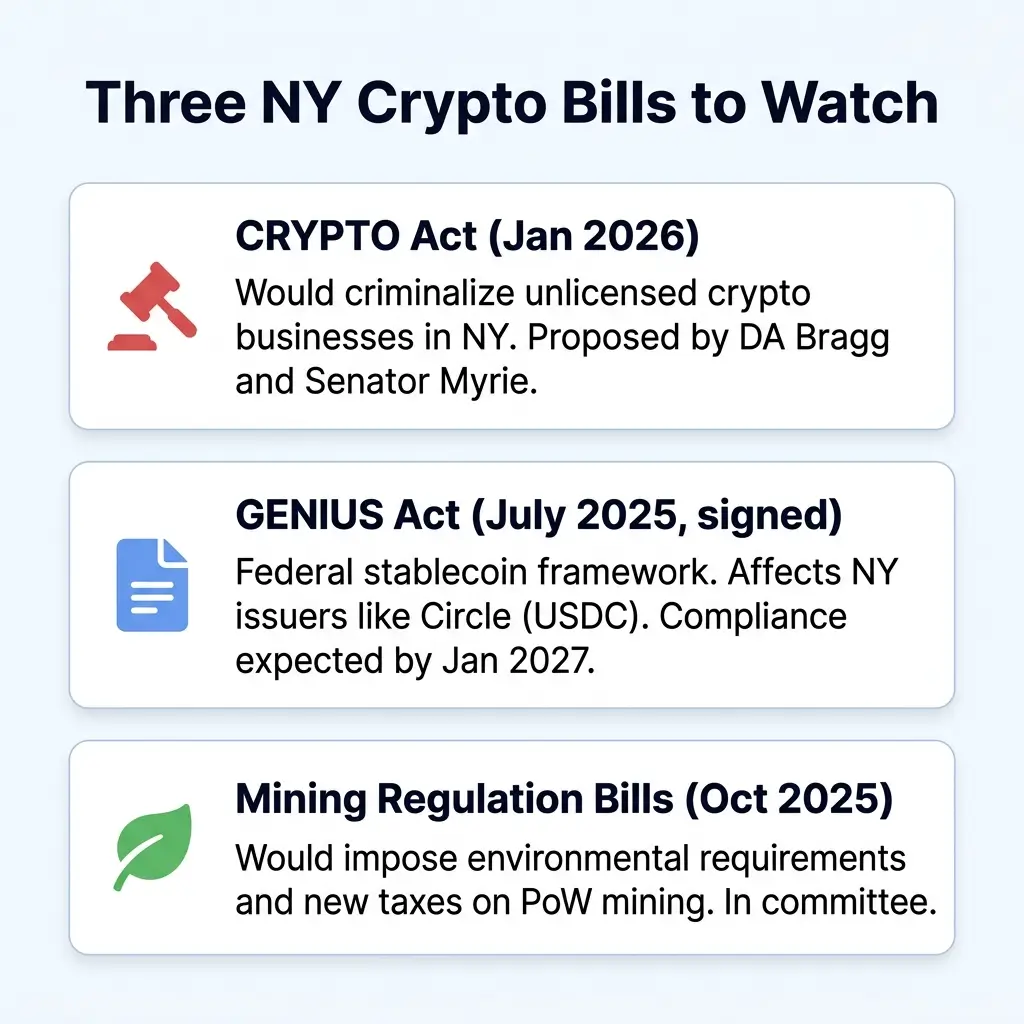
Three developments merit your attention.
- The CRYPTO Act (Cryptocurrency Regulation Yields Protections, Trust, and Oversight), introduced in January 2026 by Manhattan DA Alvin Bragg and State Senator Zellnor Myrie, would add criminal penalties for operating a virtual currency business without a license in New York [7].
If enacted, New York would become the 19th state to criminalize unlicensed virtual currency activity.
- The GENIUS Act (Guiding and Establishing National Innovation for U.S. Stablecoins), signed into federal law by President Trump on July 18, 2025, creates a federal regulatory framework for payment stablecoins [16].
This directly affects New York-based issuers like Circle, which holds a BitLicense (granted September 2015) and issues USDC, the second-largest stablecoin by market cap.
The GENIUS Act’s implementing regulations are still being drafted, with a compliance deadline expected in January 2027 [16].
How NYDFS rules interact with this new federal framework will shape the future of stablecoins issued from New York.
- New mining legislation introduced in October 2025 by Senators Krueger and Kelles would impose stricter environmental requirements on proof-of-work operations and could create a new mining tax [11].
These bills remain in committee, and their passage depends on broader political dynamics in Albany.
How to Stay Compliant
New York residents who trade crypto should follow three practices.
- First, use ONLY NYDFS-licensed exchanges. You can verify any platform’s license status directly through the NYDFS regulated entities. If a platform is not on that list, assume it cannot legally serve you.
- Second, keep detailed records of every transaction. Record the date, amount, cost basis, and proceeds for each buy, sell, or trade. Use the Greenlist to understand which assets your exchange can offer without special approval [1]. Starting in 2025, expect to receive Form 1099-DA from custodial brokers.
- Third, monitor the NYDFS website for guidance updates. The agency issued updated custodial structure guidance in September 2025, new warnings on sentiment-based virtual currencies (meme coins) in January 2025, and continues to refine its coin-listing and self-certification frameworks [1].
Crypto in New York operates under tighter rules than any other U.S. state. That regulatory pressure protects consumers, but it also limits choices.
Staying informed and using licensed platforms is the most reliable path to building a compliant crypto portfolio as a NY resident.
SOURCES
- New York Department of Financial Services, “Virtual Currency Business Licensing”, accessed March 2026
- CoinTracker, “How to buy crypto in New York: A 2026 guide”, 2026
- Reuters, “Fidelity’s crypto company secures New York state license”, November 19, 2019
- Fortune Crypto, “New York crypto regulator removes Ripple and Dogecoin from token greenlist”, September 18, 2023
- Bitget Academy, “Is Binance Legal in New York? 2026 Crypto Exchange Guide”, March 3, 2026
- Bitcoin Magazine, “Kraken Joins Exchanges Refusing to Apply for a BitLicense”, 2015
- Manhattan District Attorney’s Office, “D.A. Bragg, Senator Myrie Announce New Bill to Combat Use of Cryptocurrency to Commit Crimes”, January 15, 2026
- Hunton Andrews Kurth, “New York Enacts Crypto Mining Moratorium”, November 29, 2022
- Bloomberg Government, “NY Delays Study on Bitcoin Mining as Moratorium on Activity Ends”, November 22, 2024
- New York DEC, “Cryptocurrency Mining Operations Using Proof-of-Work Authentication Methods, Draft GEIS”, May 2025
- New York State Senate, “Krueger, Kelles Introduce Legislation to Establish Cryptocurrency Mining Standards”, October 1, 2025
- Bitwave, “How New York Taxes Cryptocurrency”, accessed March 2026
- Yahoo Finance, “New U.S. Crypto Tax Reporting Rules”, March 2026
- NYC Mayor’s Office, “Mayor Adams Takes Action to Position New York City as Global Capital of Digital Assets”, October 14, 2025
- NBC New York, “What happened to Eric Adams’ NYC token crypto launch”, January 15, 2026
- White House, “Fact Sheet: President Donald J. Trump Signs GENIUS Act into Law”, July 18, 2025

