
- Why the “Move-Back-to-Canada” Moment Is a Tax Inflection Point
- The Account Types That Most Often Cause Surprises
- 1) U.S. Taxable Investment Accounts (Brokerage)
- 2) U.S. Retirement Accounts (401(k), IRA, Roth IRA, etc.)
- 3) U.S. Savings Accounts and Cash Holdings
- 4) Health Savings Accounts (HSA): A U.S. Favorite That Canada Doesn’t Love
- 5) 529 Plans: Great for U.S. Education, Complicated Across Borders
- The Hidden Tax Exposure: It’s Not Just the Accounts, It’s the Mismatch
- What “Tax Mitigation” Really Means in a Canada–U.S. Move
- Why a Cross-Border Financial Advisor Is Different from “A Good Advisor”
- A Practical “Before You Move” Checklist for Returning Canadians
- The Move-Year Matters: It’s Rarely a “Normal” Tax Year
- Putting It All Together: A Plan That Protects What You’ve Built
Canadians living in the United States often assume that moving home will be as simple as packing up, crossing the border, and restarting life in Canada.
Emotionally, that may be true. Financially and tax-wise, it usually isn’t – especially if you’ve spent years building U.S. investment and savings accounts, contributing to an HSA, or funding a 529 plan for your kids.
If you’re a Canadian resident in the U.S. (or a Canadian citizen with U.S. ties) who’s considering a return to Canada, there’s a high chance you’re carrying a set of cross-border “financial fingerprints” that can trigger avoidable taxation if handled casually.
The good news is that with planning, you can often mitigate tax exposure, protect after-tax outcomes, and reduce future compliance headaches.
The key is to recognize that you’re not just changing countries – you’re changing tax systems, reporting rules, account treatment, and sometimes even the way your investments are allowed to be held.
This post walks through the most common U.S. accounts Canadians hold – brokerage/retirement, savings, HSA, and 529 – and explains why tax mitigation planning matters before you become a Canadian resident again.
It also explains how a cross-border advisor supports better decisions, better timing, and better long-term results.
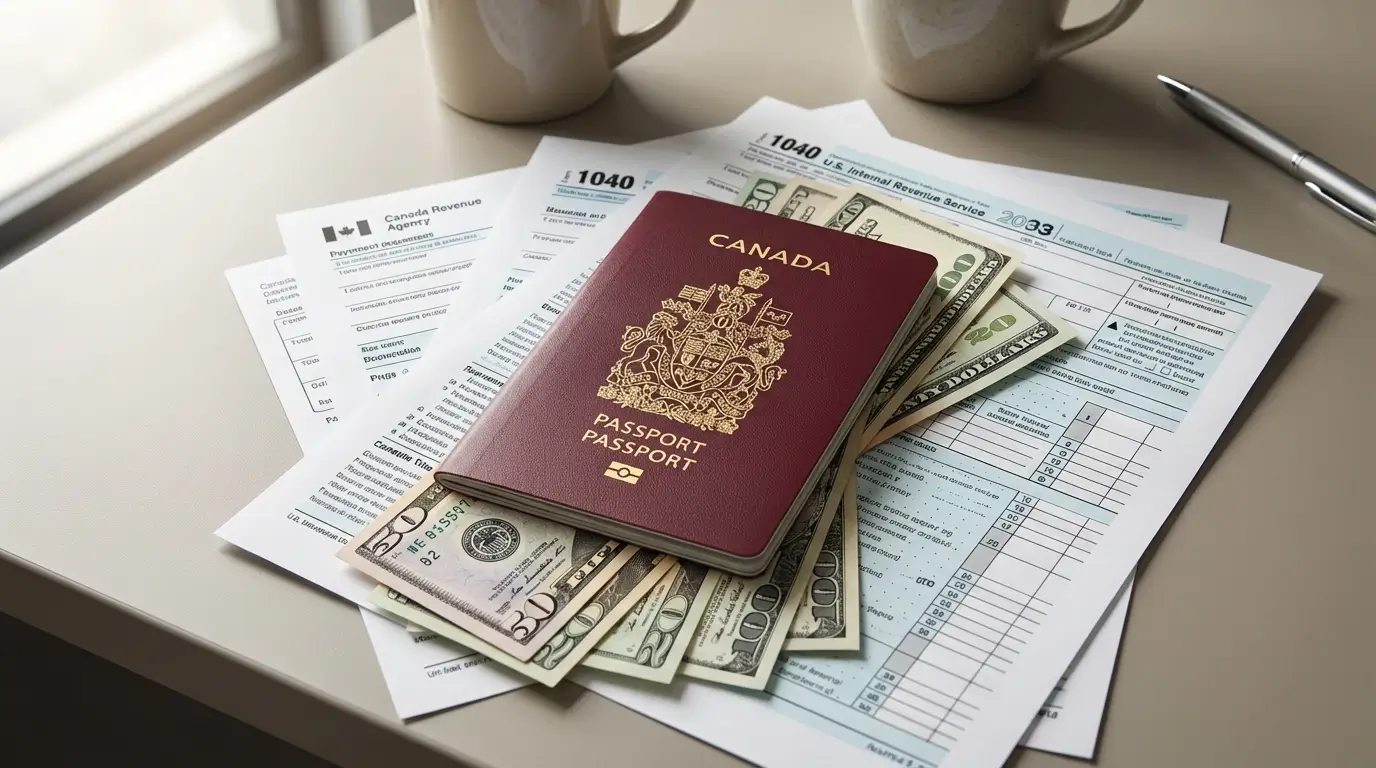
Why the “Move-Back-to-Canada” Moment Is a Tax Inflection Point
When you become a Canadian tax resident again, Canada generally taxes you on your worldwide income. Your U.S. accounts don’t stop existing, and the IRS may not stop caring either—depending on citizenship, green card status, or ongoing U.S.-source income. The move can create overlapping tax rules, treaty interactions, and mismatched account treatment.
Three issues show up repeatedly:
- Residency timing matters more than people expect. The date you become a Canadian tax resident can change what gets taxed in Canada and when. It can also affect how you report U.S. income, whether you file U.S. resident or nonresident returns, and whether treaty positions are available.
- Account labels don’t translate cleanly across the border. A “tax-advantaged” account in the U.S. may be tax-neutral or even tax-problematic in Canada (and vice versa). HSAs and 529 plans are classic examples.
- Investment selection can become a tax problem. Certain funds/ETFs that are simple in the U.S. can cause punitive Canadian taxation or compliance friction once you’re back. Likewise, Canadian mutual funds are often problematic for U.S. taxpayers.
The result is that many returning Canadians face a choice: either accept higher taxes and administrative burden, or plan ahead to lower their tax exposure.
The Account Types That Most Often Cause Surprises
1) U.S. Taxable Investment Accounts (Brokerage)
A U.S. brokerage account may look straightforward: stocks, ETFs, mutual funds, bonds, and cash. But once you return to Canada, several things can change:
- Canada may tax you on income and gains differently than you expect. Dividends, capital gains, interest, and foreign exchange effects can land differently under Canadian rules than under U.S. rules.
- Currency becomes a real tax factor. Your U.S. holdings are denominated in USD; your Canadian life expenses are in CAD. Currency movement can affect your economic outcome, and in some circumstances can complicate the taxable result you see on paper.
- Your broker may restrict your account when you move. Some U.S. financial institutions limit trading or features for clients who no longer have U.S. residency. That can reduce flexibility right when you want to rebalance, transfer, or simplify.
Tax mitigation angle:
Before returning, you may want to review cost basis, embedded gains/losses, and whether to harvest losses, rebalance, or restructure holdings into a more Canada-friendly portfolio. This is also the point to evaluate whether a transfer to a cross-border-capable custodian makes sense, and how to reduce future complexity for Canadian tax reporting.
This is where Cross-Border Wealth Management planning matters: the goal isn’t simply to keep the account—it’s to keep it in a way that reduces future tax drag and reporting friction.
2) U.S. Retirement Accounts (401(k), IRA, Roth IRA, etc.)

Many Canadians in the U.S. accumulate meaningful retirement assets in employer plans and IRAs. When you return to Canada, you typically can keep these accounts, but the tax outcome depends on how withdrawals are handled, how the treaty applies, and whether any conversions or rollovers were done at the right time.
Key issues that commonly arise:
- Roth accounts can be tricky in Canada depending on how and when you re-establish Canadian residency. Some treaty positions can preserve Roth tax-free treatment in Canada under specific conditions—but the details matter, and the wrong step at the wrong time can compromise the intended benefit.
- 401(k) and traditional IRA withdrawals may face withholding and require coordination between Canadian and U.S. tax filings to avoid double taxation.
- Required minimum distributions (RMDs) (for those subject to them) can conflict with a Canadian tax strategy or cash-flow plan.
- State tax complications may linger if your account is tied to a state with specific rules or if you maintain certain U.S. connections.
Tax mitigation angle:
Often, there are planning windows before or after the move that can reduce lifetime tax—such as strategically timing withdrawals, considering partial Roth conversions (where appropriate), planning which accounts to draw from first, and aligning your retirement income with Canadian tax brackets and credits.
This is the core promise of Canada U.S. Financial Planning: align account decisions with tax residency, treaty rules, and long-term cash flow so the same dollars don’t get taxed more than necessary.
3) U.S. Savings Accounts and Cash Holdings
Cash feels “safe,” but cross-border moves can turn cash into a planning item:
- Interest is fully taxable, and once you’re a Canadian resident, that interest becomes reportable to Canada (and potentially still to the U.S. depending on your status).
- Banking access may change once you’re no longer a U.S. resident, and you may find certain accounts are harder to maintain.
- FX strategy becomes important. A large USD cash position converted all at once can introduce timing risk. Converting slowly, using more efficient FX solutions, or aligning conversions with spending needs can reduce costs and avoid poor timing.
Tax mitigation angle:
A thoughtful plan coordinates the movement of cash, the timing of conversions, and the documentation needed for clean reporting. This is also where families often decide whether to hold an emergency fund in CAD after the move and how to handle near-term expenses (home purchase, moving costs, school, etc.) without triggering unnecessary taxable events.
4) Health Savings Accounts (HSA): A U.S. Favorite That Canada Doesn’t Love
For Canadians returning from the U.S., the HSA is one of the biggest “surprise” accounts.
In the U.S., the HSA can be a powerful triple-tax-advantaged tool: contributions may be deductible, growth can be tax-deferred, and qualified medical withdrawals can be tax-free. In Canada, however, HSAs are generally not treated the same way. The account may not retain its U.S. tax benefits from a Canadian perspective, and the annual income/growth inside the HSA may become taxable in Canada once you are a Canadian resident.
Also, HSAs are often invested in mutual funds or ETFs. If those holdings are not appropriate for Canadian residency and reporting, the complexity multiplies.
Tax mitigation angle:
Mitigation can involve evaluating:
- Whether to keep the HSA invested or simplify holdings
- Whether to use the HSA for qualified expenses before or after the move (depending on your circumstances)
- How to document expenses and withdrawals for clean reporting
- How to prevent the HSA from becoming an ongoing tax nuisance while still preserving its value
The decision isn’t one-size-fits-all. For some people, the HSA remains worth keeping. For others, simplifying or strategically drawing it down can reduce future tax exposure and administrative burden.
A cross-border advisor can coordinate this with your overall coverage plan in Canada (provincial coverage timing, private coverage gaps, planned medical spending) so the HSA supports your life rather than complicating it.
5) 529 Plans: Great for U.S. Education, Complicated Across Borders
A 529 plan is another account that can cause real confusion for returning Canadians.
In the U.S., 529 contributions grow tax-deferred and can be withdrawn tax-free for qualified education expenses. In Canada, 529 plans generally do not receive the same favorable tax treatment.
Growth may be taxable annually to a Canadian resident, and reporting can be more complex. Even if the child is ultimately educated in the U.S., the Canadian tax treatment during your Canadian residency years can reduce the intended benefit.
Add to that the practical question: if your child may study in Canada, does the 529 still make sense compared with Canadian options like an RESP? Many families end up with both—especially if a move back is uncertain—but coordinating the strategy is critical.
Tax mitigation angle:
Planning can include:
- Evaluating whether to continue contributing, pause contributions, or redirect savings
- Reviewing investment choices inside the 529 to reduce tax inefficiency for a Canadian resident
- Coordinating the 529 with potential Canadian education savings strategies
- Planning withdrawals and education funding timelines to minimize overall tax cost
The point is not that a 529 is “bad.” The point is that once your tax residency shifts, the 529 may no longer behave the way you expected—and without planning, it can quietly increase your tax exposure year after year.
The Hidden Tax Exposure: It’s Not Just the Accounts, It’s the Mismatch
When people hear “cross-border tax problem,” they often imagine a single scary event—like a big departure tax bill or a giant penalty. More often, the real cost shows up as ongoing tax drag:
- Paying Canadian tax on growth inside accounts that were meant to be sheltered
- Losing treaty benefits due to a missed election, timing issue, or administrative oversight
- Holding investments that create inefficient taxation once you’re back in Canada
- Overpaying withholding tax and failing to optimize foreign tax credits
- Creating reporting and compliance costs that persist for years
If you’re moving back permanently (or even “probably”), it’s worth treating the move as a multi-year planning project rather than a one-month relocation task.
What “Tax Mitigation” Really Means in a Canada–U.S. Move
Tax mitigation isn’t about gimmicks. It’s about aligning decisions with how each country taxes income, gains, and account growth—and using legal planning opportunities that exist precisely because cross-border moves are common.
In practical terms, mitigation often includes:
- Residency-date planning: Clarifying when Canadian residency begins (and what that means for Canada taxation), and coordinating that with U.S. filing status and treaty positions.
- Portfolio positioning: Adjusting investments so they remain efficient once you are Canadian resident—this can mean simplifying fund structures, managing turnover, and coordinating CAD vs USD exposure intentionally.
- Account-by-account strategy: Determining which accounts to keep, which to simplify, and which to draw down in a planned way.
- Withdrawal timing: Coordinating distributions from retirement plans, HSAs, and 529s with your tax brackets and credits in Canada.
- Foreign tax credit optimization: Ensuring you’re not paying tax twice due to missed credits or avoidable withholding.
- Compliance hygiene: Making sure reporting is accurate, timely, and consistent so small mistakes don’t turn into big problems.
All of this rolls up into a single idea: reduce lifetime taxes and complexity while protecting your long-term goals.
Why a Cross-Border Financial Advisor Is Different from “A Good Advisor”
A competent U.S. advisor may be excellent at U.S.-only planning. A competent Canadian advisor may be excellent at Canada-only planning. But cross-border complexity is its own discipline.
A Canada U.S. Financial Advisor can add value because they’re built to see the full chessboard:
They connect tax rules to portfolio construction
Tax is not a once-a-year event for cross-border clients. It’s embedded in investment structure, account selection, and even routine rebalancing. A cross-border advisor can coordinate your portfolio so you’re not accidentally choosing investments that work in one country but create problems in the other.
They coordinate with cross-border tax professionals
This is critical: most people need both a cross-border advisor and a cross-border tax specialist. A good advisor helps you prepare questions, gather the right data, and implement recommendations—so the tax strategy becomes a lived reality, not a PDF you never fully execute.
They help you avoid “forever accounts”
Some accounts can be kept indefinitely. Others become “forever complicated” once you’re back in Canada. A cross-border advisor helps you decide what’s worth keeping versus what should be consolidated, simplified, or strategically drawn down.
They plan the sequencing
Many people know what they own but not what order they should act in. Should you restructure investments before leaving? Should you wait until after residency changes? Should you pause certain contributions? Should you adjust withholding? Sequencing is where real tax mitigation often lives.
They reduce the emotional overload
Moves are stressful. Families are juggling schools, housing, job transitions, healthcare, and logistics. When finances feel uncertain, people tend to freeze—or make quick decisions that create expensive downstream consequences. A cross-border advisor creates a plan you can actually follow.
This is the heart of Cross-Border Wealth Management: combining planning, tax awareness, investment design, and operational support so your return to Canada doesn’t accidentally erode the wealth you worked hard to build.

A Practical “Before You Move” Checklist for Returning Canadians
Here’s a planning checklist that can help you get organized. You don’t need to solve everything at once—but you do want to identify what you’re holding and what it implies.
- List every account and its type
- Taxable brokerage
- 401(k) / 403(b) / IRA / Roth IRA
- HSA
- 529
- Bank accounts and CDs
- Stock plans (RSUs/ESPP) if applicable
- Inventory your holdings inside each account
- ETFs vs mutual funds vs individual securities
- Cost basis and embedded gains/losses
- High-turnover funds that may be tax-inefficient in Canada
- Clarify your U.S. status
- U.S. citizen, green card holder, visa status, or none
- Whether you’ll retain U.S.-source income (rental, dividends, consulting, etc.)
- Define your “return timeline”
- Permanent return vs trial move
- Whether your spouse/partner is moving simultaneously
- Whether children’s education will be in Canada or the U.S.
- Coordinate an advisor + tax specialist plan
- Build an action timeline (pre-move, move-year, post-move)
- Decide which accounts need proactive restructuring
Even this simple framework can prevent the most common mistake: moving first and planning second.
The Move-Year Matters: It’s Rarely a “Normal” Tax Year
The year you return to Canada is almost never a typical tax year. You may have:
- Split-year residency issues
- Partial-year employment income
- Withholding mismatches
- Moving-related reimbursements
- Changes to healthcare coverage
- Account contribution eligibility changes (especially for accounts tied to residency)
Tax mitigation is often about treating the move-year as a special project and not assuming your standard “annual routine” still works.
Putting It All Together: A Plan That Protects What You’ve Built
If you’ve built meaningful assets in the U.S.—retirement accounts, a brokerage portfolio, a healthy cash buffer, an HSA, a 529—you’re not starting over when you return to Canada. But without proper cross-border planning, you can accidentally donate a larger-than-necessary share of your wealth to taxes, penalties, and inefficient account structures over time.
The goal is not to eliminate taxes. The goal is to lower your tax exposure legally, reduce the chance of double taxation, preserve the intended benefits of each account as much as possible, and simplify your financial life so you can focus on the move itself.
If you’re serious about returning to Canada, this is the moment to prioritize professional guidance – especially guidance designed for cross-border realities. Done well, the outcome is not just “compliance.” It’s clarity, confidence, and an after-tax plan you can live with for the next decade.
To learn more about optimizing your return-to-Canada strategy, explore Canada U.S. Financial Planning, connect with a Canada U.S. Financial Advisor, and make Cross-Border Wealth Management a central part of your move planning—not an afterthought.

